

If you work in oil and gas, paints, rubber, friction materials, or plastics, there is a good chance that barytes powder is already part of your supply chain — even if it doesn’t always get the attention it deserves. Barytes, also spelled barite, is one of the most widely used industrial minerals in the world. And yet, many people outside of procurement and R&D functions know surprisingly little about what it is, why it matters, and how to choose the right grade.
This article breaks down the basics of barytes powder — what it is chemically, what makes it useful, and why industries from oil drilling to premium paint manufacturing have come to rely on it as an essential raw material.
What Is Barytes? The Chemistry Explained
Barytes is the naturally occurring mineral form of barium sulphate (BaSO4). In its pure form, barium sulphate is a white, odourless, tasteless powder with a very high specific gravity — typically between 4.0 and 4.5 g/cc. This high density is the single most defining characteristic of barytes and is the reason it is valued across so many industrial applications.
Naturally occurring barytes is found in sedimentary, hydrothermal, and metamorphic rock formations. In India, the states of Andhra Pradesh, Rajasthan, and Maharashtra are the primary producing regions. Andhra Pradesh — and particularly the Kadapa district — is one of the richest and most historically significant barytes mining regions in the country.
In its raw form, barytes ore is grey, off-white, or white depending on the level of associated minerals. After mining, the ore undergoes sorting, cleaning, pulverising, and air classification to produce the fine powder grades used in industrial applications.
The Key Properties That Make Barytes Valuable
Understanding why barytes is so widely used requires understanding its unique property profile. No single mineral combines all of these characteristics to the same degree:
High Specific Gravity: At 4.0 to 4.5 g/cc, barytes is one of the densest non-metallic minerals. This makes it the go-to choice whenever a heavy, inert filler is needed — most famously in oil-well drilling mud.
Chemical Inertness: Barium sulphate is highly stable and does not react with water, most acids, or alkalis at normal conditions. This inertness is critical in applications where the filler must not interfere with the chemistry of the host formulation.
Low Oil Absorption: In paint and coating formulations, a filler with low oil absorption reduces the total binder demand, which can improve economies of formulation and film properties.
Low Solubility: BaSO4 is practically insoluble in water, making barytes safe and non-leaching in environmental terms and chemically stable in wet application environments.
Fine Particle Distribution: When properly micronised, barytes powder achieves precise particle size distributions from coarse (100 mesh) to extremely fine (500 mesh). This allows it to be matched to the specific performance requirements of different formulations.
Light Fastness: Barytes does not degrade, yellow, or change colour under UV exposure. This makes it a reliable extender in exterior paints, outdoor plastics, and UV-exposed rubber products.
Heat Resistance: The thermal stability of barium sulphate allows it to be used in high-temperature applications including brake pads, friction linings, and fireproof coatings.
Low Abrasiveness: Compared to silica-based fillers, barytes has much lower abrasiveness. This extends the life of processing equipment and reduces wear in both the mixing and end-use environments.
How Barytes Powder Is Made: From Ore to Finished Product
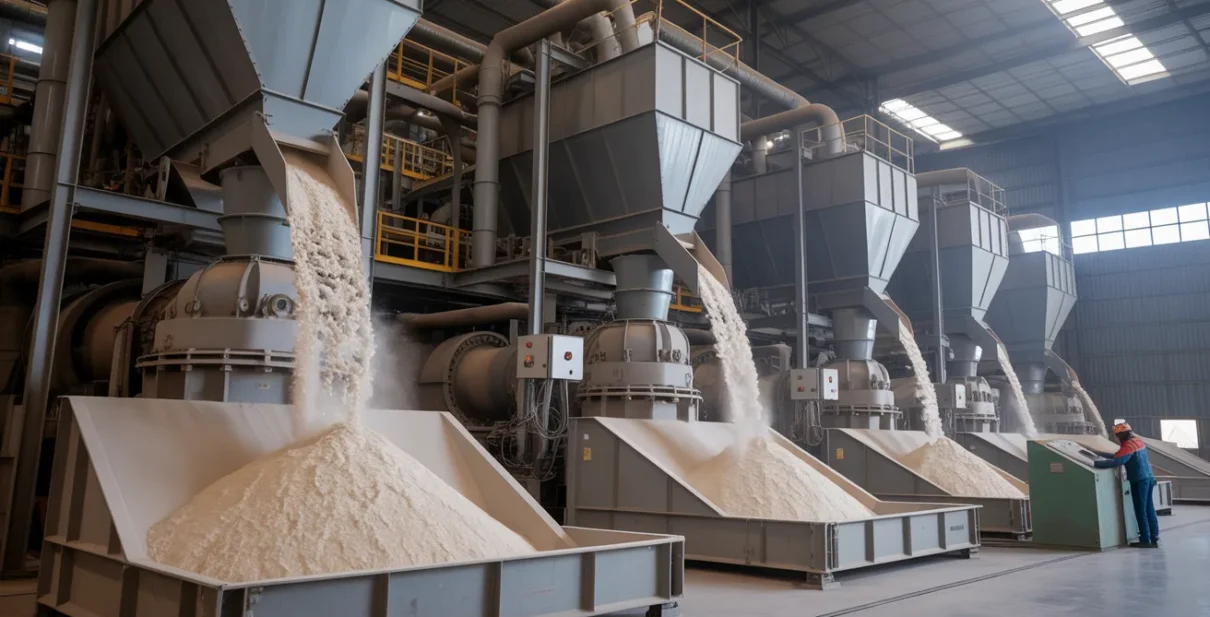
The process of producing micronised barytes powder involves multiple carefully controlled stages. Here is a simplified overview of how raw barytes ore becomes the fine powder that arrives at your factory:
1. Mining: Barytes ore is extracted from open-cast or underground mines. In Kadapa, surface mining is the most common method.
2. Sorting: Mined ore is manually and mechanically sorted to separate high-purity barytes from gangue minerals (unwanted associated rock).
3. Cleaning (Milling): The sorted ore undergoes wet or dry milling to clean and reduce the particle size to a manageable level before pulverising.
4. Vibration and Classification: A vibrator separates material by size and a Jagreser machine carries out initial classification.
5. Pulverising: The material enters an Impax pulveriser which reduces it to the target particle size — typically 100 to 500 US mesh for industrial grades.
6. Air Classification (Blower): A blower machine provides precision air classification to achieve tight particle size distribution and separate fine fractions accurately.
7. Filtration: Final filtration removes any oversize particles and ensures the product meets the specified particle size distribution on each mesh screen.
8. Packaging: The finished product is packed in 25 kg or 50 kg HDPE bags or jumbo bags and dispatched by truck to clients.
At SBMPM, this entire process is carried out across a 1,08,900 sq ft facility in Kadapa with two fully equipped mills, producing over 5,000 metric tons of barytes powder every month.
The Different Grades of Barytes and When to Use Each
Barytes powder is not a one-grade-fits-all product. The right grade depends on your application, your performance specifications, and — in some cases — cost considerations. Here is a simple guide:
Grey Barytes: The natural form, with BaSO4 purity between 60% and 95%. High specific gravity grades (G20, G30) are ideal for oil-well drilling. Mid-range grades suit rubber and friction applications. Economical grades (G70, G80) are used in construction applications.
Off-White Barytes: A cleaner, lighter form with BaSO4 purity from 70% to 95%. Preferred in paints and coatings where grey colour is undesirable but premium whiteness is not required.
Lime-Free Off-White Barytes: Specifically processed to eliminate calcium carbonate (CaCO3). Chosen for formulations where lime content causes chemical incompatibility — such as acid-curing adhesives, certain rubber systems, or coating formulations sensitive to alkalinity.
White Barytes: The premium product. BaSO4 purity up to 96% and whiteness up to 95%. Used in premium exterior paints, ceramics, glass, paper, and high-end plastic compounds where both brightness and density are required.
Why Purity and Particle Size Matter
When evaluating barytes powder, two parameters matter most: BaSO4 purity and particle size distribution.
BaSO4 Purity directly determines specific gravity. Higher purity means higher density — which is critical for drilling applications and any use case where weight performance is the primary value driver. In paints and coatings, higher purity also means better chemical stability and lower risk of interactions with other components.
Particle Size Distribution determines how well the barytes disperses in your formulation. A product with 0.5% maximum retained at 500 mesh provides very fine, homogeneous powder ideal for smooth coatings and precision rubber compounds. Coarser grades (100–200 mesh) are suitable for drilling mud and construction grouts where surface smoothness is less critical.
At SBMPM, both BaSO4 purity and particle size are tested systematically for every batch, from raw material through to finished product.
Conclusion
Barytes powder is an indispensable industrial mineral — combining high density, chemical inertness, low abrasiveness, and fine particle distribution in a way no alternative mineral fully replicates. Whether your industry is oil drilling, paints, rubber, friction materials, or plastics, the right grade of barytes powder can improve your product performance and process efficiency.
At Sri Balaji Micro Pulverising Mill, we have been producing and supplying all grades of micronised barytes powder from Kadapa, Andhra Pradesh since 2005. If you are looking for a reliable, ISO 9001:2015 certified barytes powder supplier in India, contact us for a free sample or to discuss your grade requirements.
