
- March 29, 2026
- by info@sribalajibarytes.com
- Quality & Compliance
When you are sourcing industrial mineral powder at scale, quality consistency is not optional. A single batch of off-specification barytes powder can disrupt your production line, create downstream product failures, and cost you far more in rework and lost time than the value of the material itself.
This is why ISO 9001:2015 certification has become one of the most important signals of quality management capability in the mineral processing industry. If your barytes powder supplier holds this certification, it means their quality management system has been independently audited against internationally recognised standards — and found to be compliant.
But what does ISO 9001:2015 actually mean? What does it require of a manufacturer? And how does it protect you as a buyer? This article answers those questions clearly.
What Is ISO 9001:2015?
ISO 9001:2015 is the world’s most widely adopted quality management system (QMS) standard, published by the International Organisation for Standardisation. The “2015” refers to the most recent revision of the standard.
It is not a product quality standard — it does not specify what the product must contain or how it must perform. Instead, it is a process standard: it requires that the manufacturer has a documented, systematic, auditable system in place for managing quality across every part of their operation.
The certification is awarded by accredited third-party certification bodies after a formal audit of the manufacturer’s processes, documentation, and quality management practices. It is renewed at regular intervals and subject to surveillance audits to ensure ongoing compliance.
The Seven Principles Behind ISO 9001:2015
The standard is built around seven core quality management principles. Understanding these principles helps you understand what a certified supplier is committed to:
1. Customer Focus: The primary goal of quality management is to meet customer requirements and exceed expectations. This means the supplier must understand what their customers need — specific gravity, purity, particle size, moisture — and build their processes around delivering it consistently.
2. Leadership: Top management must be directly involved in the quality management system. Quality cannot be delegated only to a QC department — it must be a leadership commitment across the organisation.
3. Engagement of People: Everyone in the organisation, at every level, must understand their role in maintaining quality. From the operator running the pulveriser to the person packaging the final product, each person’s contribution matters.
4. Process Approach: Quality outcomes are best achieved when activities and resources are managed as interrelated processes. This means the supplier’s quality system maps out every process step — sourcing, sorting, cleaning, pulverising, testing, packaging — and ensures each one is controlled and documented.
5. Improvement: Certified organisations must demonstrate commitment to continual improvement. They must analyse quality data, identify problems, implement corrective actions, and measure the effectiveness of those actions over time.
6. Evidence-Based Decision Making: Decisions about quality must be based on data and analysis, not guesswork or assumption. This is directly relevant to you as a buyer: it means the supplier’s quality decisions — which grades to supply, which batches to release, which processes to change — are based on real test data.
7. Relationship Management: The standard recognises that quality is also influenced by the supplier’s own suppliers and other interested parties. An ISO 9001:2015 certified barytes processor must also manage the quality of their incoming raw material.
What Does ISO 9001:2015 Require in Practice?
For a barytes powder manufacturer like SBMPM, ISO 9001:2015 certification means having and following a documented quality management system that covers:
Quality Planning: Defining the quality objectives for each product — specific gravity targets, BaSO4 content ranges, particle size specifications, moisture limits — before production begins.
Documented Processes: Every step in the manufacturing process must be documented, with clear instructions, responsibilities, and control points. There must be no ambiguity about how the product is made or tested.
Incoming Material Control: Raw barytes ore must be inspected and tested when it arrives at the facility. Material that does not meet specification must be identified, segregated, and either returned or dispositioned through a formal process.
In-Process Testing: Quality checks must be performed during production — not just at the end. This allows problems to be detected and corrected before they become a large off-specification batch.
Final Product Testing: Every finished batch must be tested against the full set of quality parameters — specific gravity, BaSO4 content, whiteness, silica, moisture, particle size, and others — before it is released for dispatch.
Non-Conformance Management: When a batch does not meet specification, there must be a formal process for investigating the cause, segregating the material, and preventing its release to customers. There must also be a corrective action process to prevent recurrence.
Record Keeping: All test results, process records, batch records, and quality decisions must be documented and retrievable. If you receive a batch and have a quality query, the certified manufacturer must be able to trace exactly how that batch was produced and tested.
Management Review: Top management must regularly review the quality management system — looking at customer complaints, non-conformances, audit results, and quality performance data — and make decisions to improve the system.
Internal Auditing: The organisation must audit its own quality management system regularly to verify that the documented processes are actually being followed in practice.
What Does ISO Certification Mean for You as a Buyer?
When you purchase barytes powder from an ISO 9001:2015 certified supplier, you gain several practical advantages:
Reduced Sampling Risk: You do not need to test every delivery yourself (though initial qualification testing is always recommended). An ISO-certified supplier has already tested the batch against the specification before dispatch. Their quality records are your first line of assurance.
Traceability: If a quality issue arises at your facility, you can raise it with the certified supplier and they will have the records to trace the batch back through their production and testing process — identifying exactly where and why a deviation occurred.
Consistency Over Time: Because the quality management system is audited and maintained, the processes that produce good product today are the same processes that will produce good product six months from now. You are not dependent on the individual judgment of a single person — you are relying on a system.
Supplier Credibility: ISO 9001:2015 certification from an accredited certification body is independently verified. It is not a self-declaration — it is an audited credential. This is important when you are qualifying a new supplier for a regulated or safety-critical application.
Continuous Improvement: Because the standard requires documented corrective actions and improvement processes, a certified supplier is committed to getting better over time — not just maintaining a minimum baseline.
SBMPM’s ISO 9001:2015 Certification
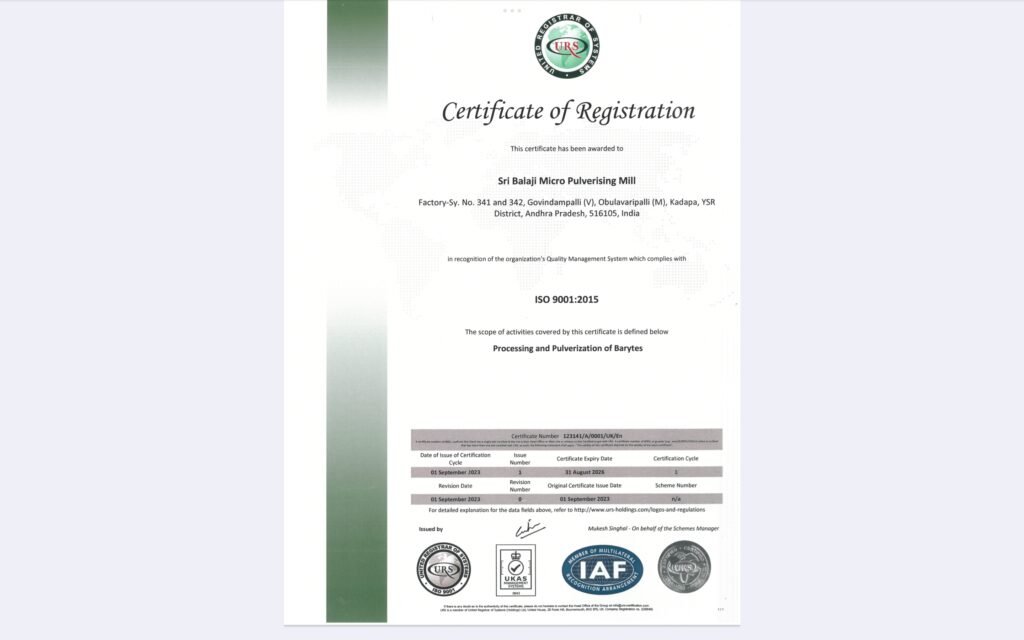
Sri Balaji Micro Pulverising Mill holds ISO 9001:2015 Certification (Certificate No. 105856/A/0001/UK/En) issued by URS (United Registrar of Systems), an internationally accredited certification body. The certification covers the scope of Processing and Pulverisation of Barytes at our manufacturing facility at Govindampalli Village, Obulavaripalli Mandal, Kadapa, Andhra Pradesh.
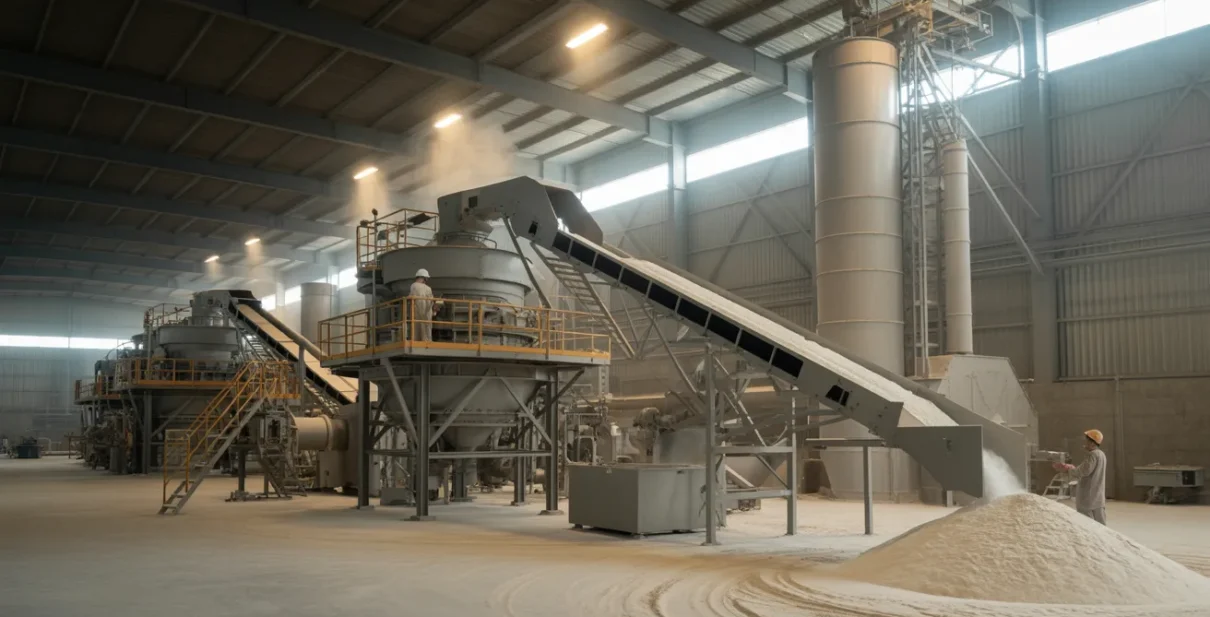
Our quality management system covers the full production process — from raw material sourcing and sorting through pulverising, air classification, filtration, testing, and packaging. Every batch is tested across eleven quality parameters before dispatch:
Specific gravity | Whiteness | BaSO4 content | CaCO3 content | Silica content | Bulk density | pH value | Ash content | Particle size | Oil absorption | Moisture content
Our quality records are maintained and available to clients. We welcome buyer audits and can provide test reports and batch records on request.
Conclusion
ISO 9001:2015 certification is not just a badge on a company’s letterhead. It is evidence that an independent, accredited body has audited and verified the manufacturer’s quality management system against internationally recognised standards — and found it to be compliant.
For buyers of industrial minerals like barytes powder, working with an ISO-certified supplier reduces supply risk, improves consistency, and gives you a documented, auditable quality foundation for your own products.
At SBMPM, we have maintained our ISO 9001:2015 certification because we believe quality management is a core business responsibility — not just a commercial requirement. If you would like to discuss our quality documentation, request a batch test report, or arrange a supplier audit, contact us.
Please select a category.
ShopBuilder for Easy Store Customization
ShopBuilder is a versatile plugin designed for Elementor Page Builder. This plugin helps you design and customize your online store easily, letting you create attractive product pages and improve the shopping experience for your customers.